“Greek cultural memory, in its dynamics and diversity, is a po(i)etic memory.”
(Calame 2019: #)
In his Description of Greece, written in the 2nd century CE, the travelogue Pausanias relates that at Tanagra in Boeotia “there are sanctuaries of Hermes Kriophoros [Hermes the Rambearer] (…). They account for the former surname by a story that Hermes averted a pestilence from the city by carrying a ram round the walls; to commemorate this Calamis made an image (agalma) of Hermes carrying a ram upon his shoulders. Whichever of the youths is judged to be the most handsome goes round the walls at the feast of Hermes, carrying a lamb on his shoulders.”1
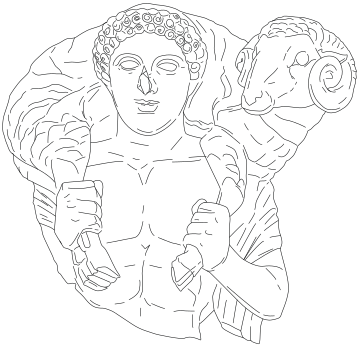
Several ways and layers of recording and remembering are at work here. A mythological event is regularly commemorated by reenacting it with actual living humans or animals taking on the role of their mythical predecessors. A sculptor, it is said, working in the first half of the 5th century BCE turned it into a three-dimensional monument, a statue of the god Hermes carrying a ram. Finally, more than half a millennium later, Pausanias recorded all of it in writing which we are only able to access because his text was copied and translated over the centuries.2 What largely eludes us is the visual and otherwise sensual experience of ritual, the myth’s living memory as performed by the inhabitants and animals of Tanagra. Calamis’ figure is lost, but might have survived in Roman marble copies, such as a fragmented statue of a young Hermes Kriophoros, today in the Museo Barracco in Rome, which depicts the god in a scheme later made familiar in Christian iconography of Christ and the lamb (fig. 1).3 The god holds the animal tight by its feet and constrains it that way, an yet the image evokes a situation of care, protection, and physical intimacy: young Herms with his “wolly” curls seems to emerge from the fleece of the ram that is twined around the god’s neck and supply resting on his shoulders.
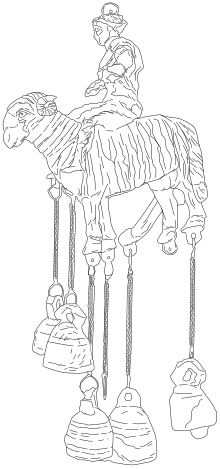
A Roman bronze wind-chime (tintinnabulum) from Pompeii presents us with a different situation. Meant to be hung from a ceiling or doorway, it showed the god Mercurius (the Greek Hermes) sitting on a ram, thus making the animal a “Hermes-bearer” (fig. 2). Whether its owners had any idea of the rites performed at Tanagra, we don’t know. But we can see and hear the object perform itself even today: little bells dangle from the ram’s hoofs and also the exaggerated genital which illustrated the animals’ percussive force as much as the power to avert evil and bring good luck through virility and fertility.4 When moved by the air or by contact with a body, the sounds of the bells might have been a delight, a disruption, a surprise, and thus a sign of divine presence. Excavated in the ruins of the ancient city buried from the eruption of Mount Vesuvius, this object was at first not on view for everybody. Classified as indecent because of its overt display of sexual organs, it was kept – as numerous other, similarly “scandalous” objects – in the secret cabinet (gabinetto segreto) of the Royal Bourbon Museum (today Naples Archaeological Museum) to which only few individuals were given access.
In all their difference, these two examples are related by a common motif: the protection of mortals by a god deploying an animal and these mortals’ attempts to commemorate the event. Yet, the contingencies of how these attempts have survived or been transmitted have shaped the ways in which they, the attempts at commemoration themselves, and their cause have been recalled and understood, up to the present day. And they will continue to do so. Memory is not of the past only, but alive, it continues to evolve and change, reaching into the present and future.
Random access memory (RAM), in French mémoire vive (“living memory”), is the general technical term for an aspect of a computer’s hardware that enables its data storage to be accessed quickly, as a kind of short-term memory. This usually proceeds in a “volatile” manner: it is only working as long the device is running; once it is shut down, the memory is lost only to be reloaded and thus re-activated when power is on again.5 In a playful allusion to the exhibition’s title, the present text discusses rams – male, not castrated sheep – and their depictions as a form of living memory in the ancient “classical,” i.e. Greek and Roman, cultures.6 Imagery of these cultures looms large in Oliver Laric’s work, as a visual reservoir to draw from, to be copied, distributed, transformed, digitally and in different materials, by himself and others.7
Circulating and sharing large datasets or “memory” has become self-evident to contemporary denizens of the digital world. But how was memory shared over time and space in societies that did not dispose of such methods of recording and storing? Scholars generally differentiate between oral delivery and ritual performance as opposed to written text as two fundamentally distinct ways of remembering and recording. Similarly, individual and collective or internal and external memory can be opposed to each other. These binary oppositions prove to be inapt, however, to account for different kinds of concepts of memories over time. They also do not capture the continuous process of transformation that constitutes memory. As Egbert Bakker reminds us, memory is “‘medially’ and therefore historically contingent.”8 Within the numerous recording techniques humans have developed, animals can play a fundamental role which deserves more attention than it is usually given. In the following, I want to look at how real animals, processed animal parts, and representations thereof could contribute to or serve as “living memories” – of individuals and of collectives – in ancient Greece and Rome.
A few preliminary remarks are in order to highlight the different meanings of “animal” in Greek and Latin and also the specific ways of how to understand memory in the ancient “classical” world. At the risk of generalization, I shall proceed mostly in a synchronic fashion, even though those aspects changed over time and could be quite distinct between Greece and Rome.9 My main concern is to point out some fundamental differences between “our” (i.e. Western, industrialized, and digitized) world and the ancient past, namely in the ways in which memory and animals were conceived.
I understand this text as a contribution to more recent posthumanist attempts to “decenter” the human. The “classical” world often appears as a place of origin of human exceptionalism Western style.10 In the wake of globalization, enduring colonialism, capitalism, and climate change, this charge has gained renewed urgency. Classicists have taken inspiration afresh from the posthumanist turn to contest that genealogy, but also to revisit their archives and complicate or reveal alternatives to ancient anthropo- and androcentrism.11 One way to do so is, as philosopher Rosi Braidotti puts it: “to move on, beyond the empire of the sign, toward a neoliteral relation to animals (…).”12 Animals are therefore understood in a web of connections that encompasses the entire kosmos, including, besides humans, the gods, plants, or the environment. In anthropologist Christopher Watts’ words, the call is to “highlight the transactions, translations, and transformations that are carried out between humans and non-humans” and consequently be “concern(ed) with the relations themselves – the linkages rather than the nodes, the actions rather than the substances.”13 In the following, I attempt to trace some of those relations without however completely letting go of “the substances,” which seems to me as impossible as giving up an anthropomorphic approach that we better remain aware of.14 Critics of posthumanism have pointed out that indiscriminately blurring boundaries or “flattening ontologies” comes with the risk of reinstating old mechanisms and strategies of domination.15 “Substances” might help to identify fundamental differences – between the various entities at play here, but also between the past and the contemporary present.
In both Greek and Latin, generic words for animal designated a “living being” (animals and humans), more specifically a “beast” (including human-animal mixed creatures). The etymologies thus suggest that real animals, humans, and eventually fantastical beasts are somehow akin. The Greek zoion is related to zoe, life, and can also denote, different from the Latin, a picture or figure.16 This means that there is eventually no clear distinction between actual and mythological, real and imagined animals, and not between an (actual) animal and its depiction. The Latin animal is related to anima, breath, but also soul, and thus characterizes animals as breathing, spirited, ensouled creatures.
What the terms do not appear to designate are gods. There is a clear separation between them and the rest. This seems at odds with the written and visual evidence that imagines the immortals as very much like humans and as living. But they do so forever! The paradox is, as prominently argued by Jean-Pierre Vernant, constitutive for imagining the incommensurability of the divine: the gods are, in relation to humans, simultaneously same and radically other.17
This has a certain correspondence in the relationship of humans to animals. Animals mediated between humans and the gods and heroes, through sacrifice or prophecy.18 In addition, they exposed humans to the unfathomable, to awe and wonder in the face of the divine, while simultaneously providing access to or making it tangible. The figure of the animal was sufficiently same and other for humans to encompass this spectrum. Animals (some more than others) possessed physical and behavioral properties that eventually made them akin to humans. At the same time, non- or rather super-human features – habitats such as the depths of the sea and the earth, exceptional strength, or skills such as flying – manifested in an all the more powerful fashion how animals eventually transcended the human sphere to be connected to the heroic and mythological world or even embody parts of it. It is in this form, next to ritual and sacrifice, that they were part of individual and collective memories.
Animal bodies, alive or not, served as a medium for humans to store and eventually reactivate memories, whether in written or oral form. Their skin, for example, was processed to produce parchment as a writing surface, sheep’s skin being particularly valued for its smoothness.19 Any kind of oral ritual performance instead would have been accompanied by musical instruments for the construction of which body parts of dead animals were deployed, such as sheep or more often cattle bones for wind instruments (so-called auloi)20. The lyre, preferred string instrument to accompany poetry and song, consisted of rams’ horns mounted laterally onto an empty tortoise shell and connected by a horizontal bar to hold the strings made of sheep’s guts.21
All this illuminates a crucial aspect of ancient, specifically ancient Greek conceptions of memory: it is something to be constantly re-activated and actualized, by artistic means, in performance, particularly dance or song, but also commemorative images such as Calamis’ Hermes Kriophoros mentioned above. As Egbert Bakker puts it: “the act of remembering will perform and make present the thing remembered.” Memory is not of the past only, but of the present as a physical experience, even when seemingly mundane activities are concerned: “remembering food, or sleep, or physical strength, in Homer means to eat, sleep, or be strong.”22 Memory similar to the idea of history for the ancients thus eludes any linear temporality: time is compressed; past, present, and future intertwined. The power to evoke it all cannot rely on humans alone; it requires divine inspiration and “super-human knowledge.”23 And indeed, guardians of poetry were the Muses, daughters of Zeus and Mnemosyne, (the goddess of) memory.24
Scholars have traced a development from oral to increasingly written forms of keeping memory. The latter was certainly more prominent in the Hellenistic and Roman periods, but it never completely replaced the former.25 Also, the two technologies, while not entirely congruent, can be closely connected as the example of weaving demonstrates, a craft related to writing and poetry already in antiquity. Weaving patterns functioned as much as mnemonic device as they could correspond to the rhythm or meter of song, similar, as has often been pointed out, to a computing mechanism.26 The production process therefore was a performance, simultaneously operational and artistic. Shorn, washed, carded, twisted, and spun, the fleeces of living sheep were transformed into wool and woven into fabric. Primarily executed by women, accomplishment of this time-consuming process would be secured by centuries if not millennia of embodied knowledge that went into every gesture of so many people involved in the fabrication. This communal activity provided the occasion for sharing individual memories or recalling mythological tales together. Not only was the final product a text(ile); its making re-performed the very stories it was referring to and eventually depicting. As a form of writing weaving gained particular poignancy for it was mastered and understood by the marginalized, those usually considered “speechless” to animals – namely women.27 Think of Philomela, raped and made speechless by her brother-in-law (he cuts off her tongue) who weaves the story of the crime into a tapestry; or the ruse of Odysseus’ wife Penelope who resists the suitors’ demand she wed one of them by constantly unraveling the fabric she promised to finish before making her decision. Women weavers could identify with these heroines.
With such a close connection between daily life activities and remembering the mythical past into the present and future, it is conceivable that the sheer presence of animals, the gestures that went with attending them, or their images triggered and activated memory in the everyday. The regular shearing of a rams’ fleece, for example, would have given repeated opportunity to recall the story of the Golden Fleece. Patting one’s own ram’s fur could evoke personal memories, but also those of myth such as blinded Polyphemus checking on his sheep. Every ram thus could be seen as an instantiation of or a true-to life, living image of one of its mythical predecessors – such as the leader of the Cyclops’ flock, for example, tied to whose belly Odysseus managed to escape the cave of his cannibal host (see Laric’s Ulysses under the ram).
In sum, given the varied circumstances of the act of reactivation at every instance, actualization of the past and of myth in ritual did not result in monotonous replication, but differed, not the least because each act of repetition recalled the previous one(s). This has similarities with how memory works, namely as continuously reloaded, actualized, and thus changing rather than sealed storage, in other words mémoire vive.
The Greek mnem(osyn)e contains the root mne/men which it shares with the term menos meaning strength or impulsive force.28 Heroic warriors possess menos. This semantic connection illustrates the physical and dynamic aspect of remembering. It aligns with non-linear temporality as mentioned earlier: memory is not only oriented backward, but also a forward moving power.
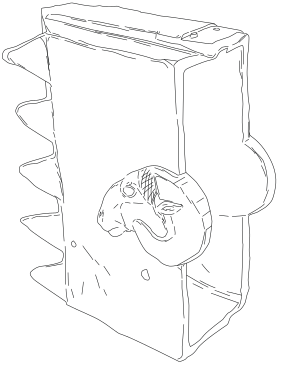
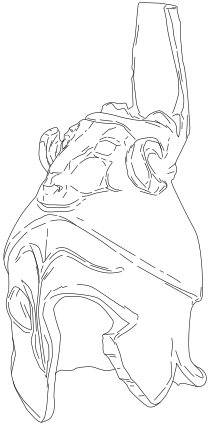
What we might call the affordance of an animal or the object that renders it can equally be related to menos. Things as animals were imagined to be animated, enlivened, acting out of their own accord and possessing their own vividness (enargeia)29. Similar to athletes or heroic warriors and their weapons, the ram has menos as much as the object featuring its image.30 The bronze encasing of a battering ram from Olympia (fig. 3) exemplifies this idea. Decorated with two rams’ heads in profile on the frame of its rear aperture, the object embodies its ancient designation: krios, aries, ram – a term used for the animal as much as for battering rams, including those of ships. Much more than a metaphor or analogy, the krios/aries/ram does not only stand in for strength, stubbornness, or aggressivity; it performs the percussive energy that is inherent to it and most clearly realized when it clashes with an opponent heads-on, in a repeated fashion at that. A similar idea is performed by rams’ heads depicted on cranium or cheek pieces of bronze (votive) combat helmets (fig. 4) or on horse frontlets.31
The root mne/men also relates to mania, madness or frenzy, which in a Greek context is connected to divine inspiration, especially that induced by Dionysos, god of theater, transformation, and intoxication.32 Next to dances, choral, and theatrical performances, drinking banquets (symposia) constituted another ritual setting during which to experience mania. While the wine changed the revelers’ state of consciousness as it spurred, embellished, or distorted their memories, banquet accoutrements added to the mind-altering event: dressed up, for example as animals, the symposiasts imbibed the intoxicating liquid from a ram’s or cattle’s curved horns (rhyta), or metal and clay mugs shaped in similar ways.33 Animal head vessels turned the drinking containers into a mask and the revelers into animals, eventually mimicking animal movements or sounds and this way communicating with those of actual animals in the immediate vicinity, donkeys in the nearby stable, sheep being guided through the alleyways, or the notorious household dog sitting underneath the table and waiting for a scrap of food.34 Besides all the fun and social bonding such masquerades entailed, they placed humans within the larger cosmic order all while having them enact moments of alterity or (con)fusion as part of ritual.
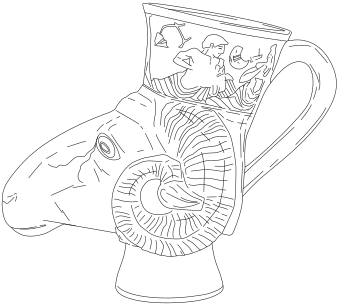
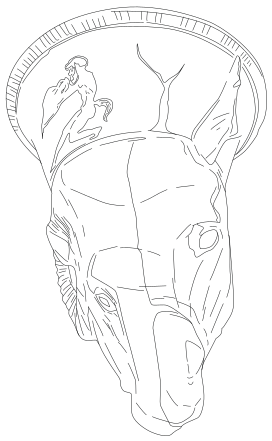
Such vessels were in use at the banquet of the living and of the dead. An example from the 5th century BCE, made in Athens, found in Italy and today on display in Richmond, VA is shaped as a ram’s head (fig. 5).35 It invited the user to experience the animals’ surface texture haptically while drinking: the delicately rippled spiral horns, the more rough and curly fur on the cranium/front, or the smooth snout. Big painted eyes with long black tear ducts add to the lifelikeness of the head. And yet it is a thing, sitting on a vessel’s foot, with a handle in the back and tapering outward into a larger aperture with broad rim. The latter features a group of reclining men, gathered for a symposium. One of them is holding a lyre. Inscriptions indicate that these are no average mortals, but Athenian heroes such as Kekrops, Pandion, or Theseus. The symposiasts using the vessel would thus have brought this mythical gathering into the present. Similarly, the ram could evoke a mythical story and induce the drinker to identify, for example, with one of Odysseus’ companions bewitched by Circe who are usually depicted as humans with an animal head.36 A so-called dimidiating drinking vessel from Greece and today in Baltimore materializes metamorphosis and/or distorted perception as resulting from frenzy by combining the halves of heads of two different animals, a ram and a donkey (fig. 6).37
Inhabitants of the Greek and Roman worlds would have been exposed to a variety of animals, domesticated and wild, to a much greater extent than most of contemporary humans who live in industrialized, urban contexts. Conversely, animal imagery (as images in general) would have been dramatically less ubiquitous than our days. Privileged spaces in which ancient Greeks and Romans could see accumulated depictions of animals would have been sanctuaries, and to a lesser extent cemeteries. The monuments erected in these venues shared a certain repertoire of theriomorphic figures and the way these were used to spatially, temporally, and symbolically frame the human. Not only did these images enliven the architecture to be beheld in amazement, ward off evil, and demonstrate the power of the deity; they also made worshippers experience the cosmic order with gods, heroes, and mythical creatures often hovering above the average men and women who performed their duties towards the gods.38 Painted and sculpted as much as real, animals helped evoke the mythical past in the present. In its entirety, a sanctuary made the idea of compressed time palpable, given that artwork had been dedicated there over centuries.
From the 3rd century onwards, in the Hellenistic and Roman Empires, as colonization, domination, extraction and exploitation of the environment, of animals and of peoples grew, the kosmos of the sanctuary would also be transferred to the palace gardens or lavish mansions of the powerful, and from there find its way into private homes. The expanded presence of animal imagery was countered by the display of actual, wild and exotic animals in royal or imperial processions, in parks, or in (amphi)theaters39. Animals could still present the mythical past in the present, if in a more contained fashion that merged art and nature in spectacular ways.
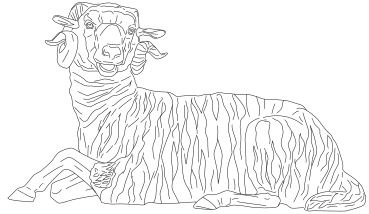
The marvelous bronze of a resting ram from the Castello Maniace in Syracuse (Sicily), today in Palermo and dated to the 2nd century CE (but eventually copying a Hellenistic prototype), might be a remnant from such as setting (fig. 6). Scholars have proposed that it could have belonged to a larger group of animals – a second ram from the same site survived until the 19th century – that formed part of a mythological scenery, such as the Cyclops Polyphemus sitting among his flock while Odysseus and his companions, fastened to the bellies of some of the animals are trying to escape.40 The scene has been captured in many different media over the centuries with similar iconography (see Laric’s Ulysses under the ram).
Yet not only the subjects of such zoia or figures but also their making are connected to how the ancients thought about generating memories. As seen earlier, the craft of weaving shared mnemonic and performative techniques with poetry. Greek philosophers such as Plato thought of memories as images captured in the wax tablets of the mind, similar to the act of making an impression (typos) e.g. with a seal ring.41 This technique of replication is kindred to that of making molds used both by potters and bronze sculptors. The animal head vases discussed above were both mold-made (fig. 5 and 6). While this allowed for quick and precise replication, it also facilitated new combinations as the half ram/half donkey dimidiating vessel demonstrates. Bronze casting (fig. 2-4.7) made not only use of molds, but also of wax that in the process was replaced by liquid bronze. Here too, use of the same molds did not necessarily lead to exact replicas, but left leeway for alterations.42 Sculpted copies such as the marble Hermes Kriophoros (fig. 1) however did not result from being ‘in touch’, in other words an indexical relationship with their prototype, but needed to be translated from one three dimensional positive to another. That opened the possibility for a wide spectrum of modifications, variations, and transformations of one and the same type – similar to how the working of memories is imagined nowadays.43
In his introduction to Classics and Media Theory, Pantelis Michelakis lists “three metaphors (…) of the concept of the medium: media as conduits (i), medias as languages (ii), and media as environment (iii).” The first encompasses materials, “tools and devices”, the second images and words whether written or performed, and the third designates conceptual and perceptual environments” including “topologies of media such as memory (…).”44 As I have attempted to show, animals as media of memory are in all three of these. Without animals, whether dead or alive, actual or depicted, human memory as living memory would have been incomplete.
I thank Oliver Laric for the invitation to write this essay. Thanks also to Michael D. Morris for discussion and critique.
1.Pausanias, Description of Greece 9.22.1–2; translated by William H. S. Jones. ↩
2.The earliest extant manuscript date to the early 15th century: Diller 1957. In its entirety, the Description of Greece can be described as memory work: Alcock – Cherry – Elsner 2001. ↩
3.PietrangeIi 1960: 57 cat. no. 83. Calamis’ statue would have been created around 480 BCE; but it is also possible that the piece at the Museo Barracco is a Roman creation in the style of the early 5th century BCE. ↩
4.Parker 2018. ↩
5.There is however a broader spectrum of RAM including non-volatile types, which are beyond the scope of this paper; https://en.wikipedia.org/wiki/Random-access_memory and https://en.wikipedia.org/wiki/Non-volatile_memory (both accessed March 20, 2023). The generally volatile RAM is different from non-volatile memory or mémoire rémanente where data is persisted without power. I am grateful to Amanda House for clarification of many of these points. ↩
6.Many of the points made here can be transferred to other animals, such as female sheep or cattle. While (at least some) animals were thought to possess memories themselves, this is not my concern here; but see Baroin – Valette-Cagnac 1994. ↩
7.Crowley 2021. ↩
8.Bakker 2008: 65; Michelakis 2020a and 2020b on the constitutive role of media in knowledge production of the ancient world. ↩
9.Bettini – Short 2018. ↩
10.e.g. Descola 2013: 63-66. 277. ↩
11.Franco 2018; Bianchi – Brill – Holmes 2019. ↩
12.Braidotti 2009: 528. ↩
13.Watts 2013: 1. ↩
14.Daston – Mitman 2005. ↩
15.Chesi – Spiegel 2020. ↩
16.LSJ s.v. ζᾦον. OLD s.v. animal. Not all meanings were in use simultaneously. ↩
17.Vernant 1989. ↩
18.Bodson 1978; Kindt 2021. ↩
19.The use of papyrus would have been more common. ↩
20.The instrument functioned more like an oboe. ↩
21.Carrington 1961. ↩
22.Bakker 2008: 67. On ritual performance see also Kowalzig 2007. ↩
23.Castagnoli 2019: 239. ↩
24.Vernant 1965: 51-94; Castagnoli 2019: 239; Agócs 2019:69-71. The Roman equivalent of the goddess would have been Moneta whose sphere of power is different in that the name derives from monere (to remind, to advise, to mne/warn). ↩
25.Calame 2019; Wiseman 2014. ↩
26.Harlizius-Klück 2015; Nosch 2014; Tuck 2006. ↩
27.Heath 2011. ↩
28.e.g. Bakker 2008: 67-76; Beekes 2010: 929-931. 953-4. ↩
29.e.g. Bielfeldt 2017. ↩
30.Compare Homer, Iliad 3.196-198; 13.491-495. ↩
31.Kunze 1956; Heilmeyer et al. 2012: 406 cat no. 3.27; Fawcett 1994; Neer 2018: 472-474. For the linguistic connections between horn and head see Nussbaum 1986: #. ↩
32.Ustinova 2012. ↩
33.Dressing up: Steinhart 2004; Rothwell 2007; Weiss 2021. Vessels: Lissarrague 1987; Ebbinghaus 2018: 226-241. ↩
34.Ebbinghaus 2018. ↩
35.Ebbinghaus 2018, 195-203. ↩
36.Contrary to the story in Homer, they are not just transformed into pigs. Wannagat 1999; Ebbinghaus 2018. ↩
37.Ebbinghaus 2018: 220-222. ↩
38.Marconi 2004; 2005. ↩
39.Coleman 1990; Gilhus 2006; Miziur 2012-13. ↩
40.Gans 2005. ↩
41.Plato, Theaetetus 191d; Platt 2020; on connections to writing Agócs 2019. ↩
42.Mattusch 1996. ↩
43.Didi-Huberman 2008; Anguissola 2014. ↩
44.Michelakis 2020b: 4-5. ↩